
COLUMNIST
BUILDING AKWA IBOM’S AEROTROPOLIS : UMO ENO’S VISION OF AN AVIATION CITY

BUILDING AKWA IBOM’S AEROTROPOLIS : UMO ENO’S VISION OF AN AVIATION CITY
By Emmanuel Ndon
An airport becomes an economic centre when the activities surrounding it extend beyond aircraft arrivals and departures. Maintenance facilities, cargo handling, accommodation, aviation training, healthcare and commercial services can transform an airport environment into an integrated urban and industrial district. This is the concept behind an aerotropolis, and Akwa Ibom State is advancing this model around the Victor Attah International Airport under Governor Umo Eno’s administration.
The vision represents a new stage in the state’s aviation development. The airport was conceived during the administration of former Governor Victor Attah, its principal runway infrastructure was developed under Governor Godswill Akpabio, and the establishment of Ibom Air and the development of the modern terminal and aircraft maintenance facilities advanced under Governor Udom Emmanuel. Governor Umo Eno’s administration is extending this foundation through international aviation operations, aviation-worker housing, cargo infrastructure and supporting facilities intended to bring the different elements together.
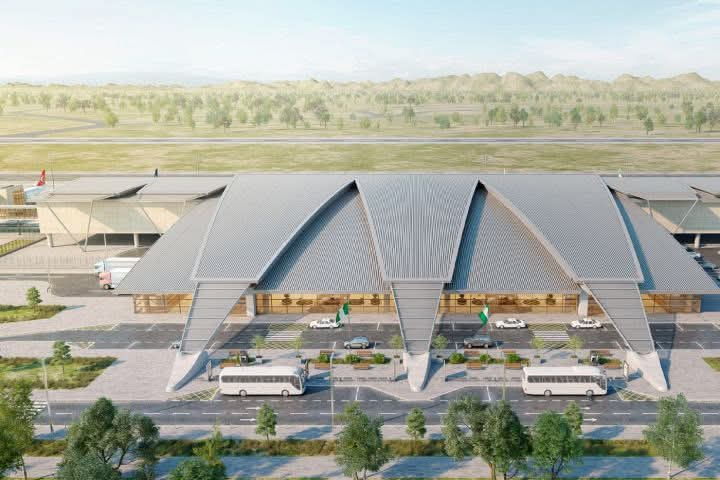
A major milestone came with the opening of the international terminal and the commencement of international operations. The state’s maiden international flight to Accra, Ghana, demonstrated the airport’s expanded connectivity and introduced a new dimension to Akwa Ibom’s relationship with regional destinations. The terminal, equipped with modern passenger-processing facilities, provides the principal gateway for this expanding network, while the administration’s investments in airfield lighting, navigational aids, taxiways, aircraft aprons and security systems support the wider operational environment.
One of the most visible components of the aerotropolis concept is the Aviation Village, for which Governor Eno performed the groundbreaking ceremony in November 2024. Its first phase comprises 100 residential units: 50 two-bedroom apartments and 50 three-bedroom flats intended for personnel drawn from aviation-related agencies and organisations. The housing is designed to place essential workers closer to their duty stations within an industry where flight schedules, aircraft maintenance, security and emergency response require reliable staffing at different hours of the day.
The Aviation Village is more than a residential development in the airport vicinity. It forms part of a planned aviation community whose subsequent phases have been described as including an aviation school, a model school, a shopping centre and other supporting amenities. These proposed facilities would extend the development beyond staff accommodation into education, training and everyday services. The first phase establishes the residential base around which this overall concept has been articulated.
Aircraft maintenance is another critical part of the emerging aviation ecosystem. The Maintenance, Repair and Overhaul facility, commonly known as the MRO, is intended to provide specialised technical services for aircraft. Such facilities occupy an important position in aviation because aircraft require regular inspections, scheduled maintenance and technical work throughout their service lives. A functioning MRO operation in Akwa Ibom would create opportunities for aviation engineers, technicians and other skilled professionals while positioning the state to participate in a specialised segment of the aviation industry.
The administration has also pursued the development of an international medical facility at the airport, alongside the airport clinic and other support infrastructure. Medical services within an aviation environment serve airport employees, passengers and other users, while specialist healthcare infrastructure can complement the wider concentration of services around the airport. The integration of accommodation, healthcare and technical facilities reflects the practical requirements of an aviation district whose activities extend beyond the terminal.
Cargo and logistics are equally important to the aerotropolis vision. In March 2026, Governor Eno secured approval for a bonded terminal following a meeting with the Comptroller-General of the Nigeria Customs Service, Bashir Adewale Adeniyi. A bonded terminal provides a customs-controlled environment for handling eligible imported or exported goods under applicable procedures. In conjunction with international air connectivity and planned cargo operations, the approval adds a trade and logistics dimension to the state’s aviation development.
Human-capital development is also receiving attention. In September 2026, Governor Eno disclosed that ten cadet pilots were undergoing training in Addis Ababa, Ethiopia, under state government sponsorship. The administration has also highlighted the participation of Akwa Ibom indigenes among Ibom Air’s pilots and engineers. These investments connect the physical expansion of aviation infrastructure with the development of the professionals needed to operate, maintain and manage aviation services.
The aerotropolis concept also gives the surrounding area a distinct development dimension. Housing for aviation personnel, educational facilities, healthcare services, maintenance operations and logistics infrastructure create different forms of demand for accommodation, retail, transportation, technical services and skilled labour. As these activities develop around the airport, they form part of an emerging economic corridor linking aviation with the wider urban and commercial growth of Uyo and its environs.
Governor Eno’s administration has reinforced this direction through the creation of a dedicated Ministry of Aviation and Airport Development, providing a specialised institutional structure for coordinating the sector’s expanding responsibilities. The ministry’s remit brings the airport, airline development and supporting aviation infrastructure within a more focused administrative framework. This is particularly relevant as the state pursues international connectivity, technical aviation services, cargo handling and the development of facilities beyond the main terminal.
Akwa Ibom’s aerotropolis is therefore not a single building or a standalone housing estate. It is a developing network of aviation and supporting facilities, anchored by the Victor Attah International Airport and Ibom Air. The international terminal, Aviation Village, MRO facility, medical infrastructure, bonded terminal initiative and investment in aviation personnel represent different parts of that wider undertaking. Together, they show how the state is extending its aviation strategy from operating flights towards building an environment in which aviation-related businesses, services and skilled professionals can operate alongside one another.
Under Governor Umo Eno, the development of this aviation ecosystem marks a significant chapter in the state’s long-running investment in air transport. The objective is to establish an integrated aviation city in which passenger services, aircraft maintenance, cargo logistics, workforce accommodation and professional development reinforce one another. The Aerotropolis concept gives these investments a common direction, placing aviation at the centre of a broader programme of infrastructure, employment and economic expansion in Akwa Ibom State.