

Connect with us
POLITICS1 day ago

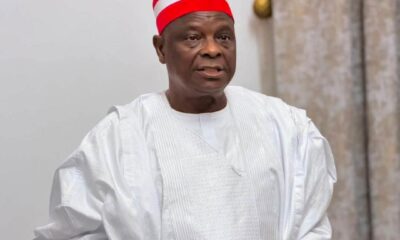
It’s illegal for you to release El-Rufai just like that — Falana, Effiong, Akinnola rebuke ICPC Criticisms have followed the release of former Kaduna State Governor Nasir El-Rufai from custody without recourse to the court that ordered his remand, highlighting the entrenched cultures of disregard for court orders and selective enforcement in the country. Senior lawyer Femi Falana described the former governor’s release as illegal and amounted to overruling the court. “What they did is wrong and illegal. No agency or individual, no matter how powerful, can overrule the court. El-Rufai was detained pursuant to a court order, and only the court can reverse it,” Premium Times reported Mr Falana, a Senior Advocate of Nigeria (SAN), saying on Saturday. Also, human rights lawyer, Inibehe Effiong, and veteran journalist Richard Akinnola expressed surprise at the development in separate social media posts on Saturday. Mr El-Rufai’s son, Bashir El-Rufai, announced his imminent release from custody of the Independent Corrupt Practices and Other Related Offences Commission (ICPC) on X late on Friday. Sources at the ICPC further said on Saturday that the former governor was released to enable him to mourn and participate in the burial rites of his mother, who passed away Friday. Mr El-Rufai had been detained since 18 February based on a court order. On 24 March, the Federal High Court in Kaduna, Kaduna State, renewed the detention order by further remanding him in ICPC custody shortly after the agency arraigned him on corruption charges. The judge, Ridwan Aikawa, ordered Mr El-Rufai’s remand till Tuesday, scheduled for the hearing of his bail application. Reacting to the news of the former governor’s release in a social media post on Saturday, Mr Effiong said ICPC has a question to answer “A person who’s remanded by an order of a court cannot be released legally without recourse to the court,” Mr Effiong wrote. “ICPC Nigeria, can you clarify the procedure adopted in this case? El-Rufai’s motion for bail is slated for Tuesday, March 31, 2026. How was his release processed?” Mr Effiong asked if the development is “another government magic that the legendary Fela sang about?” Veteran journalist, Mr Akinnola, also expressed surprise at the release on Saturday. “Mallam Nasir El-Rufai, unfortunately lost his mother yesterday while on court remand in ICPC custody. El-Rufai’s bail application has not yet been heard. The court ordered that he be remanded in ICPC custody pending the hearing of his bail application next week. So, under which order did the ICPC release him for his mum’s burial? I don’t get it,” Mr Akinnola wrote on Saturday. The case also highlights the inequality among Nigerians who have a brush with law in a country where many ordinary citizens spend years in prison to await trial. Many Nigerians detained over criminal allegations are often not offered similar privilege when faced with pressing need for a temporary freedom. “Nigerian authorities must learn to operate under the Rule of Law. There are ordinary people in custody who have lost both parents. Why are they never released in this manner to participate in the burial rites of their loved ones?” Mr Falana said. He said the appropriate thing to do “is to rush an application to the court seeking his release to enable him to participate in the burial rites of his mother. The prosecution and the defence could exchange processes electronically. The application could then be filed on Monday, accompanied by an affidavit of urgency so that it could be held the same day.” Mr Akinnola said on Saturday that it would have been a different thing Mr El-Rufai had not been charged in court, “hence, ICPC could have released him on compassionate grounds, even though he was being illegally held. But since the court is seized of the matter, the agency cannot whimsically release him.” The case shines light on a less-known dimension to how authorities treat court orders with scant respect in the country. What often happens is that authorities disobey court order for the release of individuals from custody. The reverse is the case in Mr El-Rufai’s situation where an agency disobeys a court order for detention of a defendant. ICPC arraigned Mr El-Rufai alongside Joel Adoga on 10 charges of corruption on 24 March. In the charges filed on 18 March, ICPC accused Mr El-Rufai of fraudulently taking inflated severance pay of about N289.8 million at the end of each of his two terms in office, instead of N20 million that he was legitimately entitled to on each occasion. The anti-graft agency alleged that Mr El-Rufai took the first N289.8 million in September 2020 – after completing his first term in office in May 2019 – and the second N289.8 million in January 2023 – months before the end of his second term in May 2023. The pays totalled N579.7 million, instead of the about N40 million he was said to be entitled to for the two terms. The commission added that each of the pays “represents 300% of your annual basic salary which you reasonably ought to have known that such fund formed part of the proceeds of an unlawful act, to wit: corruption.” It said the offences were contrary to Section 18(2}(d) and punishable under Section 18(3) of the Money Laundering (Prevention and Prohibition} Act, 2022. In the other eight counts, ICPC accused Mr El-Rufai of receiving deposits of alleged proceeds of corruption and fraud totalling $817,900 in tranches in his Guaranty Trust Bank (GTB) domiciliary account. He allegedly received the deposits while he was serving as the governor of Kaduna State. ICPC said Mr El-Rufai, who served two terms as governor from May 2015 to May 2023, received the deposits in tranches, ranging from $4,000 to $320,800. He allegedly received the deposits in the same domiciliary account from various individuals between 2016 and March 2023. His co-defendant, Mr Adoga, appeared as a defendant in only one out of the 10 counts. But the commission named him in another count as one of the persons who deposited money in Mr El-Rufai’s dollar domiciliary account. They both pleaded not guilty to the charges. ICPC rearrested Mr El Rufai on 18 February as soon as the Economic and Financial Crimes Commission (EFCC) released him after two days of detaining him over corruption allegations. Mr El-Rufai has described his prosecution as a political persecution, drawing on the fallout between him President Bola Tinubu after his failed nomination to serve as minister in President Tinubu’s cabinet. He also described his prolonged detention by the ICPC as illegal in the N1 billion fundamental rights enforcement suit he filed after the ICPC agents searched his house on 19 February. But the ICPC countered the suit in its filing before the Federal High Court in Abuja, saying both his detention and the search of his residence were based on court orders.

It’s illegal for you to release El-Rufai just like that — Falana, Effiong, Akinnola rebuke ICPC Criticisms have followed the...

More News