
COLUMNIST
TINUBU IN UYO: THE VISIT THAT WILL DECIDE AKWA IBOM’S NEXT 50 YEARS

TINUBU IN UYO: THE VISIT THAT WILL DECIDE AKWA IBOM’S NEXT 50 YEARS
Seaport, Universities, Roads, Aviation — And Why Unity Is Now Our Greatest Bargaining Power
By Ephraim Okon, Ph.D
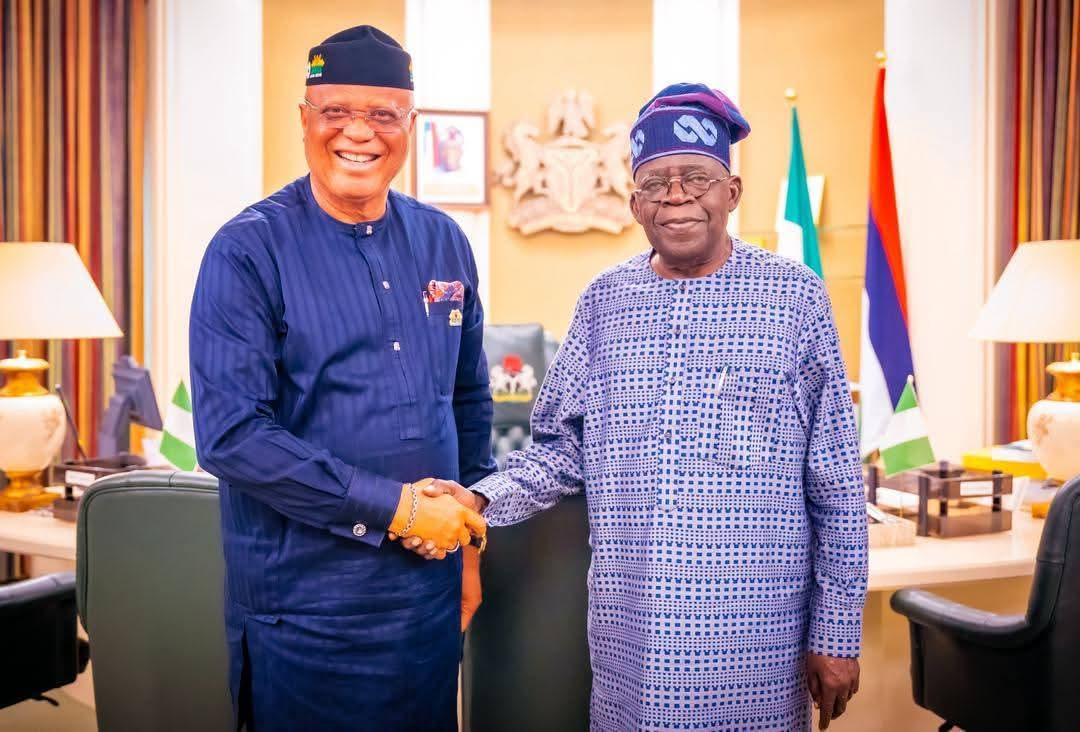
Barring any last-minute change, President Bola Ahmed Tinubu will land in Uyo today. On the surface, he has come to commission projects — an airport terminal, a palm resort, a ring road. But beneath the surface, something far bigger is happening.
For the first time in 25 years, Akwa Ibom is not going to Abuja to beg for a seaport. Abuja is coming to Akwa Ibom to see why it must now deliver one.
For the first time in our history, we have a Senate President from Akwa Ibom, a Governor who has united PDP and APC, Federal universities in Ikot Abasi, Obio Akpa and a Federal College of Education at Ididep, a Police Academy in Ukana, a Federal Medical Centre in the making, a Coastal Highway cutting through our coast, and an airline, Ibom Air that is the envy of Nigeria.
The President has not come to see buildings. He has come to see a State that has made itself impossible to ignore. The question now is: Will this visit end with applause, or will it end with a date — a date for financial close for the Ibom Deep Seaport?
That is what this visit is really about.
WHY THIS VISIT MATTERS
Presidents do not visit every state. They visit where there is progress to show, where there is partnership to strengthen, and where there is a story to tell Nigeria. Akwa Ibom State Government and Akwa Ibom State today has all three.
Under Governor Umo Eno’s ARISE Agenda, the State has pursued a quiet but determined revolution — roads, schools, hospitals, airports, and jobs. The President will commission the new International Terminal Building at Victor Attah International Airport, the International Airport Hospital, and the Ibom Aviation Village. He will commission the AKWA-GIS Office Complex, the Command and Control Centre, and the ARISE Palm Resort. He will commission the Airport-Okopedi Road and Ring Road 3.
These are not just buildings. They are signals. An international terminal says Akwa Ibom is ready for the world. An aviation village says we are not just buying planes, we are building an aviation economy. When a President commissions, he also endorses. And endorsement at this level brings investor confidence, federal attention, and national respect.
AKWA IBOM UNITED: THE FOUNDATION
None of this would have been possible without peace. And peace in Akwa Ibom today has a name: Akwa Ibom United.
Governor Umo Eno came into office with a clear philosophy — that this State must move as one. “This state moves as one. Since I came on board, I have deepened the Akwa Ibom United mantra, and we are operating as one all around.” In practice, it means projects are not shared by political loyalty, but by need across all 31 Local Government Areas. It means former political opponents are not humiliated, but embraced.
As Governor Eno said at the State’s 39th anniversary: “Our peace is priceless. Our unity is priceless. Our brotherhood is priceless. Political differences must never become personal hatred. Ethnic differences must never become division.”
That is why, even as he moved from PDP to APC in June 2025, he refused to divide the State. Investors do not go where there is crisis. Federal Government does not invest where there is confusion. Akwa Ibom United is therefore not just a slogan. It is our greatest economic strategy.
To sustain this, we must continue to deepen inclusion — ensuring that every community, every party, and every generation feels that Akwa Ibom United includes them.
AKPABIO’S FOOTPRINTS: FROM GOVERNOR TO SENATE PRESIDENT
Akwa Ibom’s progress cannot be understood without Distinguished Senator Godswill Obot Akpabio, The Senate President – Nigeria. His footprints are in two eras. As Governor (2007-2015): He changed the physical face of Akwa Ibom — the Godswill Akpabio International Stadium, the Ibom E-Library, the Ibom Specialist Hospital, the network of dualised roads that opened up Uyo, the free and compulsory education policy, and the vision of a modern state. He taught Akwa Ibom to dream big. He laid the foundation on which every governor after him has built.
As Senate President (2023 till date): He is now building institutions, not just infrastructure. He is using the Number 3 office in Nigeria to bring Federal presence home. The Akwa Ibom State House of Assembly recently commended President Tinubu, Senate President Akpabio, and Governor Eno together for bringing new federal institutions to the State, specifically acknowledging Akpabio’s legislative leadership.
When the President, the Senate President, and the Governor stand together during this visit, Akwa Ibom speaks with one voice to Abuja. That is a rare privilege. We must not waste it. The next step is to ensure that these institutions receive the staffing, funding, and infrastructure to thrive, so that the promise becomes performance.
FEDERAL UNIVERSITIES AND FCE IDIDEP: LINKED TO THAT FOOTPRINT
The most visible fruit of that voice is in education.
Federal University of Technology, Ikot Abasi (FUTIA): Established in 2021, now with its Establishment Bill passed by the Senate in October 2026. In just a few years, FUTIA has grown to 36 NUC-approved programmes, including Biomedical Engineering, Mechatronics, Biotechnology, and Computer Engineering. Akpabio laid the foundation for its Senate Building and School of Engineering, and has said FUTIA will serve “the global community, not just Nigerians.”
Federal University of Agriculture and Technology, Obio Akpa: Approved by President Tinubu, facilitated by Senate President Akpabio, supported by Governor Eno who released the Obio Akpa campus for immediate take-off. Pioneer Vice-Chancellor, Professor Joseph Essien, is already on ground.
Federal College of Education, Ididep, Ibiono Ibom: This is the foundation of the whole pyramid. Established by the Federal Government in May 2023, FCE Ididep is training the teachers who will teach our children. It matriculated 583 pioneer students in 2024/2025, now has about 700 students, a 520-capacity lecture theatre, and is expanding. It was midwifed by Senator Ita Enang, who provided initial scholarships for indigenes, and it now stands as part of the same Federal footprint that Akpabio’s leadership in the Senate is consolidating — from NCE teachers at Ididep, to technologists at Ikot Abasi, to agriculturists at Obio Akpa.
Federal Police Academy, Ukana, Essien Udim: Approved under President Tinubu, located in Ukana — in the home district of the Senate President. It will train the next generation of police officers for Nigeria.
More in the pipeline: Federal University of Medical Sciences, Eket, and full university status for the University of Maritime Studies, Oron. From Ididep to Ikot Abasi to Obio Akpa to Ukana, the story is one: Akwa Ibom is no longer just sending its children to other states for quality education. Other states will now send their children to Akwa Ibom.
PRIVATE UNIVERSITIES: THE OTHER PILLAR OF THE EDUCATION ECONOMY
But the Federal story is only half the story. The other half is private investment in education — proof that the enabling environment in Akwa Ibom works.
Akwa Ibom today has three thriving private universities, alongside the University of Uyo (Federal) and Akwa Ibom State University (State):
Topfaith University, Mkpatak, Essien Udim: Approved by NUC in 2021, an extension of the renowned Topfaith Schools. It matriculated its first students in May 2022, now runs 26 programmes, and has full NUC accreditation to 2028. It is a model of indigenous private investment turning local excellence into a university.
Ritman University, Ikot Ekpene: Founded in 2015, focused on entrepreneurial education, building young problem-solvers, not just certificate holders. It has become a major employer and intellectual hub in the Ikot Ekpene Senatorial District.
Obong University, Obong Ntak, Etim Ekpo: Founded in 2007 by the Church of Christ, affiliated with Harding University in the United States. One of the first private universities in the State, it has quietly produced graduates for nearly two decades.
Add to these the private polytechnics — Heritage Polytechnic, Eket, Sure Foundation Polytechnic, and others — and the picture is clear: Akwa Ibom is not just a state where government builds schools. It is a state where private citizens feel safe enough to invest their own money in education.
Why does this matter for the President’s visit? Because investors watch other investors. When a Topfaith or a Ritman succeeds, it tells a Lagos investor, a diaspora investor, a foreign investor: “Your money is safe in Akwa Ibom. Your project will not be destroyed by politics. Your land will not be taken. Your staff will be safe.” That is the enabling environment. Government creates the ground. Private sector builds on it. That is growth. Going forward, we can strengthen this further by streamlining approvals, improving power and water to campuses, and encouraging partnerships between private universities and the new Federal institutions.
HEALTH INSTITUTIONS: THE PATRICK UMOH EFFECT
If education is the mind, health is the heart. And in health, one name stands out: Hon. Dr. Patrick Umoh, Member Representing Ikot Ekpene, Essien Udim and Obot Akara, and Chairman, House Committee on Health Institutions. As Chairman, he oversees every Federal health institution in Nigeria. That position has been used deliberately for Akwa Ibom:
Federal Medical Centre, Ukana — HB.2082: Sponsored by Dr. Umoh to establish a Federal Medical Centre in Ukana, Essien Udim.
Federal College of Nursing and Midwifery, Eket — HB.363: To train nurses and midwives for our new hospitals.
Federal College of Nursing Sciences, Ikot Mboho: Another federal health training institution attracted through his Committee.
Beyond Bills, he has delivered health centres, donated 3 ambulances, supported 100 women in the State Health Insurance Scheme, and supported the Haemodialysis Unit at Ikot Ekpene General Hospital. His scorecard: 66 bills, 18 motions, 120 federal jobs facilitated, over 700 empowerment items. The opportunity now is to link these new Federal health institutions with the State’s primary health centres, so that training, referral, and care form one seamless system for the people.
FEDERAL ROADS: THE ROADS THAT WERE ONCE IMPASSABLE
The President’s visit is also about roads — the Federal roads that connect Akwa Ibom to Nigeria.
Aba / Umuahia – Ikot Ekpene Road: For years, this 49km Federal highway was a nightmare. It was awarded in 2019, stalled, and became impassable — vehicles trapped in mud, businesses cut off, lives lost. Under President Tinubu, FEC approved N14.37 billion augmentation in February 2025, and 8.42km of failed sections were completed. President Tinubu then approved the handover of the 25km Phase Two to Abia State under a refund arrangement, while the Federal contractor continues on Phase One.
Calabar – Odukpani – Itu – Ikot Ekpene Highway: This vital commercial artery linking Cross River to Akwa Ibom has lingered for years. The Joint National Assembly Committee on Works declared a state of emergency on it in October 2025 after oversight showed slow progress, terminated and re-awarded some contracts, and ordered Hitech to take over a 9.7km section.
Lagos – Calabar Coastal Highway: The flagship 750km legacy project. Akwa Ibom is a major beneficiary. Section 3A is 41km inside Akwa Ibom, now at about 18% completion with 9km of Continuously Reinforced Concrete Pavement done, and 90% compensation paid. Section 5 is another 62km in Akwa Ibom, with over 20% progress in less than three months. In total, about 107km of the Coastal Highway will pass through Akwa Ibom. The Presidency has insisted the full 750km alignment remains intact, and will not be diverted to the East-West Road.
These roads matter because a Seaport without roads is a port without a hinterland. A university without roads is a campus without students. Federal roads are the veins. The Seaport will be the heart. Sustained Federal-State collaboration will be needed to keep these projects on schedule.
IBOM AIR AND THE AVIATION ECONOMY: THE LOGISTICS TRIANGLE
We cannot talk about roads and seaports without talking about the sky.
Ibom Air is no longer an experiment. It is Nigeria’s most reliable sub-national airline. What began in 2019 with two aircraft is now a 10-aircraft carrier — seven Bombardier CRJ-900s and three brand-new Airbus A220-300s. As of September 2026, it had carried 4,953,512 passengers on 65,152 scheduled flights. It serves seven domestic destinations and Accra, Ghana, and plans to expand to 12 destinations and 15 routes by 2027 — including Douala, Libreville, and Malabo.
But the real story is the ecosystem around it. The new International Smart Terminal covers 27,173 square metres, handles up to three million passengers annually, with five boarding bridges. The MRO facility is 90% complete. The apron is 98% complete. The Aviation Village, the Airport Hospital, the second runway, perimeter fencing, and taxiway are all part of one aerotropolis — a city within a city.
And the human capital: 14 of Ibom Air’s 30 pilots are Akwa Ibom indigenes. 16 of its 40 engineers are indigenes. Another 20 pilots trained in Paris, 10 cadet pilots in Addis Ababa, 16 engineers at Ethiopian Aviation University, 10 dispatchers at NCAT Zaria. Captain Ruth Adebanwo made history as the first woman to fly a new aircraft into Nigeria. This is the logistics triangle: Air + Road + Sea. Ibom Air brings people and cargo by air. Coastal Highway moves them by road. Ibom Deep Seaport will move them by sea. No other state in the South-South has all three coming together at once. The next constructive step is to fully operationalise the MRO, expand cargo handling, and deepen partnerships that create more aviation jobs for Akwa Ibom youths.
WOMEN, YOUTH AND AGRICULTURE: WHERE ARISE TOUCHES THE ORDINARY PERSON
Infrastructure is good. Institutions are good. But development must touch the market woman, the young graduate, and the farmer.
Under the ARISE Agenda, Governor Eno has deliberately targeted those groups. Women cooperatives have been empowered with grants and equipment. Youths have been trained in aviation, ICT, agriculture, and entrepreneurship — not just given handouts, but given skills. The Ibom FADAMA programme, the palm oil revival, and support for cassava, fish, and livestock farmers are turning agriculture from subsistence to business.
The Federal University of Agriculture and Technology, Obio Akpa, is therefore not an abstract project. It is the academic anchor for this rural economy. The farmers of Obio Akpa, Ini, Ikot Ekpene, and Ibeno will have researchers, extension workers, and graduates working with them.
When the President commissions projects, he should also see the women who now have health insurance, the youths who now fly planes, and the farmers who now sell to markets beyond their village. That is ARISE in human form. We can build on this by expanding access to markets, storage, and affordable credit, so that empowerment becomes sustainable enterprise.
SECURITY AND PEACE: THE QUIET REASON INVESTORS COME
There is a quiet reason why all this is possible: Akwa Ibom is peaceful. In a region where many states struggle with cult clashes, kidnapping, and sit-at-home disruptions, Akwa Ibom has remained one of the most stable states in the South-South. There is a functional security architecture — the Command and Control Centre the President will commission, community policing, and a governor who resolves conflict before it becomes crisis. Investors do not go where they fear. The Federal Government does not put a Federal University, a Police Academy, a Medical Centre, and a Coastal Highway in a state it does not trust. The fact that Abuja trusts Akwa Ibom with these institutions is itself a security certificate. Peace is not the absence of noise. Peace is the presence of justice, inclusion, and opportunity. That is Akwa Ibom United. We must continue to protect this peace, and to keep investing in community engagement, youth opportunities, and early conflict resolution, so that peace remains our competitive advantage.
THE IBOM DEEP SEAPORT: HISTORY, CONTOURS, AND WHAT WE MUST DO
Now we come to the heart of this visit: The Ibom Deep Seaport.
History: Conceived in 1999 by Governor Victor Attah, who placed a deep seaport at Ibaka in Mbo as the anchor of his dream. Carried by every governor since — Attah, Akpabio, Udom Emmanuel, and now Umo Eno. In 2012, under President Goodluck Jonathan, the Federal Government approved plans for Nigeria’s first deep seaport at Ibaka. In May 2015, FEC approved the Outline Business Case for Ibom Deep Seaport. In April 2012, then Governor Akpabio, at the South-South Economic Summit in Asaba, framed it not as a state prestige project, but as a national response to Lagos congestion — vessels waiting weeks to berth, driving up costs for pharmaceuticals and imports. He reminded Nigeria that Ibaka had 15 to 17 metres natural depth, identified as suitable as far back as 1963.
Contours: The current design is ambitious: $4.2 to $4.6 billion, 2,566 hectares within the Ibom Industrial City, with provision for 1,565 hectares expansion, 14,517-hectare industrial zone in the wider plan. 18-metre draft, 20km approach channel, 7.5km quay, specialised terminals for containers, dry bulk, liquid cargo, crude and LNG. Designed for Post-Panamax vessels of 80,000 deadweight tonnage and above. Structured as a 50-year Public-Private Partnership, with Federal Government through NPA, Akwa Ibom State Government, and private core investor in 20:20:60 equity. Projected to generate over 300,000 direct and indirect jobs between 2027 and 2050.
What has been done under Governor Eno: Feasibility, master plan, site-specific studies completed. Full business case approved by ICRC and FEC. In mid-2026, Governor Eno relaunched works, met investors in Paris who had pulled out before, and they are now showing interest. He led a 104-man delegation including Senate President Akpabio to President Tinubu in March 2025 to canvass support. On October 14, 2025, Akwa Ibom members in the National Assembly moved a motion directing the Federal Government to collaborate with the State to realise the port. The groundwork has been laid.
What the State still needs to do:
Settle the location question once and for all. The discussion over Ibaka versus Seaside / Ibeno, and natural harbour versus dugout port, has slowed investor confidence. Akwa Ibom must continue to speak with one technical voice, publish a transparent Environmental Impact Assessment, and give investors certainty. Investors value clarity.
Provide sovereign comfort. Unlike Lekki, which was private-sector led, Ibom is a subnational project. It needs Federal guarantee, Federal equity clarity, and presidential pronouncement as a national project.
Fix the hinterland. Complete the Coastal Highway sections, the Calabar-Itu-Ikot Ekpene road, and the rail link to the port.
Protect host communities. Pay compensation fully, create a community trust, and ensure Oro, Ibeno, Mbo and all coastal communities see themselves as owners, not bystanders.
CHALLENGES AND THE NEED FOR COLLABORATION
We must be honest. There is still some doubt in some quarters. Some say: “We have heard Seaport for 25 years.” Some ask why the Governor moved to APC. Some in Oro feel the port has been moved from their land. Some outside Akwa Ibom ask why build another port when Lagos already has Lekki.
These concerns are understandable after 25 years of waiting. The constructive response is not to dismiss them, but to address them with clarity, inclusion, and delivery.
Collaboration is not surrender. It is the Constitution. Seaports are on the Exclusive Legislative List. Only the Federal Government through NPA can approve, license, and guarantee a deep seaport. No governor, however rich, can build it alone. Governor Eno has said it himself: “This is not a project that can be embarked upon by the Akwa Ibom State Government alone.”
And collaboration is already working. Look at the evidence: FUT Ikot Abasi, Federal University of Agriculture Obio Akpa, FCE Ididep, Police Academy Ukana, Federal Medical Centre Ukana, Coastal Highway, Aba-Ikot Ekpene Road — all came because Akwa Ibom chose partnership over protest. If collaboration could bring universities, health institutions, and highways, it can also bring a seaport, if we stay united and focused.
THE POLITICS OF DEVELOPMENT AND BROTHERHOOD: CROSS-PARTY COLLABORATION
But there is something deeper happening in Akwa Ibom that this visit reveals — something beyond projects and roads. It is what we may call the politics of development and brotherhood.
And it is not about one man. It is about a whole political culture that Governor Umo Eno has deliberately created: a government of Akwa Ibom, not a government of a party.
Back in 2025, when rumours were swirling that Governor Umo Eno was preparing to move from PDP to APC, many feared division. Akwa Ibom had a long, chequered history with the PDP. The move looked unthinkable. The political temperature was high. Many expected a split — PDP versus APC, old versus new, Uyo versus Ikot Ekpene.
The opposite happened.
Governor Eno refused to make the move a war. He did not purge PDP members. He did not humiliate those who stayed. He did not force anyone to follow him. He said, in effect: “Party is a vehicle. Akwa Ibom is the destination. If you want to walk with me to the destination, you are welcome, whatever party you are in. If you want to stay in your party, you are still my brother.” That is cross-party collaboration in practice, not in slogan.
1. The PDP-APC Bridge
The Governor, who came to power on PDP, now works hand-in-hand with Senate President Godswill Akpabio of the APC — the man who was once seen as his political opposite. Together, they led a 104-man delegation to President Tinubu in March 2025 to canvass for the Deep Seaport. Together, they have facilitated Federal universities, a Police Academy, and health institutions. Two men, two parties, one Akwa Ibom. That bridge alone would have been impossible in the old politics.
Governor Eno also kept PDP leaders in his government. He did not sack commissioners, aides, and board members because they refused to decamp. He kept technocrats, professionals, and community leaders because they could deliver, not because they carried an APC card. His cabinet, his boards, and his campaign structure today include PDP stalwarts, APC leaders, and people who have never belonged to any party at all.
2. Onofiok Luke — Not as an Exception, But as an Example
Hon. Dr. Onofiok Luke — former Speaker, former Member of the Federal House, a man who served since Vision 20:2020 as personal assistant to then-Governor Akpabio — said plainly he would not join the APC, citing deeply personal reasons and enduring loyalties. But he also said he had long given his absolute commitment to support Governor Umo Eno for a second term — not just because the governor was deserving, but because the man is a brother. He would not jump ship. He would not oppose the Governor. He would work quietly to honour his pledge through 2031.
Months later, he took the microphone and publicly reaffirmed that stance — to walk with the Governor to the very end. To many it was shocking. To those who knew, it was not a new promise. It was an old promise finally amplified in the market square.
Onofiok is important, but he is not alone. He represents dozens of PDP leaders, former governorship aspirants, former House members, former local government chairmen, and former opponents from the bruising 2023 election who today sit comfortably in Governor Eno’s campaign structure — not because they were bought, but because they were embraced.
3. Beyond APC and PDP
Governor Eno’s tent is even wider than two parties. When Professor Pat Utomi, a leading light of the national opposition, landed in Uyo recently, he could not hold back his admiration, confessing publicly that people from other parts of the country ought to be bused into Akwa Ibom to witness firsthand how a subnational entity should truly be governed. That is not a PDP man praising a PDP governor. That is an opposition leader praising a governor from another party, because governance, not party, is the test.
The same spirit is seen in the National Assembly. Akwa Ibom’s Senators and House members — across party lines — moved together on October 14, 2025, to demand Federal collaboration on the Deep Seaport. Hon. Dr. Patrick Umoh, APC, chairs Health Institutions. Other members, from different backgrounds, have worked together for FCE Ididep, for FUTIA, for roads. In Abuja, they do not fight as PDP versus APC. They fight as Akwa Ibom.
4. The Grassroots
In the 31 Local Government Areas, Governor Eno has insisted that projects go by need, not by party. A PDP village gets a road. An APC village gets a school. A community that voted against him in 2023 still gets a health centre. That is why there is no opposition village that feels punished. That is why there is no APC village that feels entitled. That is why the State is peaceful.
As Dr. Martin Luther King Jr. wrote: “The ultimate measure of a man is not where he stands in moments of comfort and convenience, but where he stands at times of challenge and controversy.”Governor Eno stood at a moment of challenge — a party switch that could have torn the State apart — and chose brotherhood over bitterness. He turned former adversaries into stakeholders. He turned opponents into partners. He turned a party move into a state movement. In just a few short years, he has methodically dismantled old animosities through sheer emotional intelligence, maturity, and a governance model that places peace above partisan pettiness.This is the real Akwa Ibom United. Not a slogan on a banner. A lived reality: PDP and APC working together. Old opponents sitting at the same table. A Governor who can call the Senate President his partner, Onofiok Luke his brother, Pat Utomi his admirer, and the market woman in Ikot Ekpene his boss — all in the same week.
That is why Akwa Ibom is the envy of the federation. Other states have governors. Akwa Ibom has a unifier.
To keep this unity strong, we must continue to listen — especially to those who still have reservations, especially in coastal communities — and ensure that everyone feels heard, included, and respected.
PRUDENT MANAGEMENT: MONEY THAT WORKS, NOT MONEY THAT FLOWS
To those who complain that money is not ‘flowing’ in the streets as it once did, we must answer plainly: That is precisely the point. Governor Eno has shown that money should not ‘flow’ arbitrarily unless it is earned — and that every dime into the state’s purse must be put to meaningful use. By plugging financial loopholes that drained state resources, clearing arrears of obligations, and tightening the fiscal space, he has shown that prudent management beats populist tokenism every single day.
That is why, despite receiving the same federal allocations as others, Akwa Ibom can commission an International Terminal, an Aviation Village, a Palm Resort, and Ring Road 3 in one visit — while still paying workers, pensioners, and contractors. That is stewardship. That is why the President can come and see value, not waste.
The constructive next step is to continue translating this prudence into lower costs for ordinary people — better transport, better storage for farmers, and more jobs for youths — so that prudent management is felt in the household as well as in the project.
To our brothers in Oro, Ibeno, Mbo, and all coastal communities: Your pain is real. Your land is precious. No port can succeed without you. We must listen, we must compensate, we must include. But we must not chase the world away. If we fight over location while Lagos, Badagry, and Lekki move, the ships will go elsewhere, and our children will ask us why we chose pride over prosperity.
PRIVATE SECTOR AND DIASPORA: DEVELOPMENT IS NOT GOVERNMENT ALONE
We must also acknowledge what government did not build: the private sector.
Beyond the three private universities, Akwa Ibom has seen private hospitals, private schools, hotels, real estate, and small industries grow because the environment is enabling. Ibom Icon Hotel and Golf Resort, now managed under the ARISE Palm Resort brand, shows how public assets can be run with private efficiency. Heritage Polytechnic and other private polytechnics show how local entrepreneurs invest in skills.
And the diaspora — Akwa Ibom sons and daughters in Lagos, Abuja, London, Houston, and Toronto — are watching. When they see peace, when they see a terminal, when they see Ibom Air landing on time, they send money home. They build houses. They start businesses. They return. Government cannot do it alone. The role of government is to create the enabling environment: peace, roads, power, water, rule of law, and predictable policy. The role of the private sector is to build on it. Akwa Ibom is now getting that balance right. That is why Topfaith, Ritman, Obong, and dozens of other private investors have stayed. The President’s visit should therefore be a signal to the private sector and diaspora: “Come home. The ground is ready. The government will not fight you. The State will protect you.”
THE RIVERS CONNECTION: TWIN ENGINE OF THE NIGER DELTA
The President goes to Rivers State tomorrow for a political rally. That is not a coincidence. It is a reminder that Akwa Ibom and Rivers are the twin engine of the Niger Delta.
Together, they produce a huge share of Nigeria’s oil and gas. Together, they host the Coastal Highway. Together, they will host the future of Nigeria’s maritime economy — Rivers with its existing ports, Akwa Ibom with its deep seaport. Together, they are the gateway to the Gulf of Guinea. If Akwa Ibom and Rivers cooperate — on roads, on security, on maritime, on investment — the entire South-South rises. If they compete and fight, the whole region loses to Lagos.
This visit, therefore, is not just about Akwa Ibom. It is about a new Niger Delta — a Niger Delta that is not defined by militancy and oil theft, but by ports, aviation, universities, and peace. Akwa Ibom is showing the way. Rivers can join. The Federal Government must support both.
LET THIS VISIT END WITH A DATE, NOT JUST APPLAUSE
Mr. President, welcome to a united Akwa Ibom.
Welcome to a State that has chosen peace over division, progress over politics, and partnership over protest. We are united behind you. We are united behind our Senate President. We are united behind our Governor.
We are hopeful — and we have reason to be hopeful — that this visit will be worthwhile. Not just a visit of commissioning, but a visit of commitment. Not just a visit of applause, but a visit of action.
We look forward, with optimism, to an outcome that will change the story of Akwa Ibom for the next 50 years:
A clear commitment on the Ibom Deep Seaport — from approval to construction, with a clear timeline, a clear location, and a clear Federal guarantee. A date for financial close before the end of 2027. A signal to investors that the ships are coming.
New investment in roads in Akwa Ibom State — not just the roads we commission today, but the roads that will connect our farms to markets, our ports to hinterland, our universities to students. Completion of the Lagos-Calabar Coastal Highway sections in Akwa Ibom.
Completion of the Calabar-Itu-Ikot Ekpene Highway. And the full dualisation of the Aba-Ikot Ekpene Road, so that the road that was once a nightmare becomes a modern dual carriageway worthy of two great commercial cities.
Completion of the East-West Road — that long-delayed artery from Edo through Rivers to Cross River, which passes through the heart of the Niger Delta. When the East-West Road is completed, Akwa Ibom will no longer be at the end of the road. It will be at the centre of the road.
Revitalisation of the Aluminium Smelter Plant in Ikot Abasi — ALSCON, the giant that has slept for too long. If ALSCON roars back to life, Ikot Abasi will roar back to life. Jobs will return. Power will be utilised. FUTIA will have an industrial partner next door. The Deep Seaport will have cargo to carry. The Aluminium Plant, the University of Technology, and the Seaport — three giants in one corridor — will form the greatest industrial belt in West Africa. Imagine it, Sir: A seaport at Ibaka. A smelter at Ikot Abasi. A university of technology at Ikot Abasi. An aviation hub at Uyo. A coastal highway linking them all. A people united across party, across ethnicity, across generation. That is not a dream. That is a plan. That is what this visit can unlock.
Most folks across the 31 LGAs do not realise how lucky we are to have been blessed with a succession of intentional, development-oriented governors over these past decades. For those who have travelled far and wide, the difference could not be clearer. Akwa Ibom is working, and we must all join hands to project that truth to the world.
This is the complete story: Universities for the mind, Health Institutions for the body, Roads for connection, Aviation for speed, Seaport for the economy, Aluminium for industry, Private Sector for growth, Brotherhood for the soul. That is Akwa Ibom United in action. That is the Akpabio footprint continued. That is the ARISE Agenda fulfilled.
So let history record that on November 6, 2026, the President did not just visit Akwa Ibom. He launched an era. An era of development in Akwa Ibom State. An era of jobs. An era of ports and planes and industries. An era where our children will not need to leave home to succeed, because home will have become the place where the world comes to succeed.
Akwa Ibom is ready. Akwa Ibom is united. Akwa Ibom will ARISE.
And this time, the ships will come.
God bless Akwa Ibom State. God bless the Federal Republic of Nigeria.
Abom Ephraim Okon, Ph.D
Lawyer, Development and Strategic Communication Expert, and Special Assistant to the Governor of Akwa Ibom State on Grassroots Mobilisation.
#TinubuInUyo #AkwaIbomUnited #ARISEAgenda #IbomDeepSeaport #AkwaIbomState #GovernanceInAction
 #NigerDeltaRising