HEALTH
Government Reaffirms Commitment to Ibom Specialist Hospital, Announces Major Healthcare Investments

Government Reaffirms Commitment to Ibom Specialist Hospital, Announces Major Healthcare Investments
The Akwa Ibom State Government has reaffirmed its commitment to strengthening healthcare delivery, stating that the Ibom Specialist Hospital remains a major beneficiary of ongoing investments despite claims suggesting the facility has been neglected.
The Commissioner for Health, Dr. Ekem Emmanuel John, said the administration of Governor Umo Eno has continued to allocate substantial resources to modernising the hospital through equipment upgrades, infrastructure maintenance, specialised medical programmes, and workforce expansion.
Speaking during an interview, the Commissioner dismissed reports alleging that the government had abandoned the hospital, describing such claims as inaccurate and unsupported by available evidence.
According to him, recent interventions at the facility include the recalibration of the Intensive Care Unit (ICU), the maintenance of the Magnetic Resonance Imaging (MRI) machine approved by Governor Umo Eno in November last year, and the replacement of the obsolete Computed Tomography (CT) scanner with a modern 128 slice CT scanner, which became operational in February this year.
Dr. John explained that the previous CT scanner had reached the end of its service life after its manufacturer discontinued technical support, making the acquisition of a newer system necessary to sustain quality diagnostic services.
He stressed that the administration has consistently demonstrated a policy of completing and improving inherited public assets rather than abandoning them. As examples, he pointed to the completion of the new airport terminal and the Ibom Tropicana International Conference Centre, projects initiated by previous administrations but delivered under Governor Umo Eno.

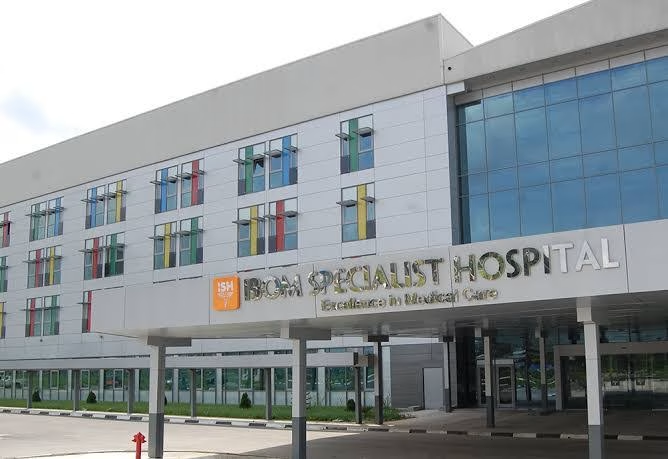
Ibom Specialist Hospital
The Commissioner also clarified the scope of the Ibom Medical City initiative, explaining that the Ibom International Hospital represents only one component of the larger healthcare ecosystem. He said the project will also include an Advanced Diagnostic Centre for specialised and molecular investigations, as well as a hospitality facility designed to accommodate patients’ relatives, following globally recognised healthcare models.
According to him, the long term objective is to position Akwa Ibom as a regional destination for advanced medical care, reduce dependence on medical tourism, and retain healthcare spending within the state and the country.
Highlighting another milestone, Dr. John disclosed that the state’s kidney transplant programme, established under Governor Umo Eno’s directive, has successfully performed nearly 1,000 kidney transplant procedures with a high success rate. He added that the programme now attracts patients from several African countries and Europe because of its affordability, quality of care, and shorter waiting periods.
The Commissioner further announced that the state government has recruited 2,854 healthcare professionals to strengthen service delivery across public health facilities. He said appointment letters are currently being processed, describing the recruitment exercise as another demonstration of the administration’s commitment to building a stronger healthcare system.
He also revealed that healthcare facilities recently completed by both the state and federal governments are gradually becoming operational following the recruitment of medical personnel. According to him, one Chief Medical Director has already resumed duty, while additional strategic appointments are expected to be concluded within days.
Providing an update on the Akwa Ibom State University Teaching Hospital and the proposed College of Medicine, Dr. John said contractors are expected to return to site within the next two to three weeks. He expressed confidence that the teaching hospital would be completed before November with a substantive Chief Medical Director in place, while the College of Medicine could commence academic activities before the end of the year once the remaining requirements are fulfilled.
He maintained that healthcare remains a central pillar of the ARISE Agenda, noting that sustained investments in hospitals, medical equipment, specialist services, health insurance, medical education, and human resources reflect the government’s determination to improve access to quality healthcare for residents of Akwa Ibom State.
Source: AkwaIbomTimes